Look at a roof, a ramp, or a hiking trail. You can tell right away whether it is flat, gentle, or steep. In math, slope is the number that measures that steepness. It tells you two things at once: which way a line tilts, and how fast it rises or falls.
Understanding slope is one of the most useful skills in algebra. You see it on homework, on school graphs, and in everyday measurements. In this guide, we break down what slope means. We explain rise over run with a complete diagram. We look at the four types of slope. Finally, we walk through a worked example step by step.
What is slope in plain English
At its heart, slope is a rate of change. It compares vertical movement to horizontal movement. Think about walking up stairs. Each stair has a height you step up. Each stair also has a flat space where your foot lands. Tall steps feel steep. Long, shallow steps feel gentle.
We draw lines on a grid using an x-axis and a y-axis. A straight line has a constant slope. That means the ratio between the vertical step and the horizontal step never changes. You can test your coordinates with our slope calculator and see how to write complete linear equations in our slope-intercept form guide.
Understanding rise over run
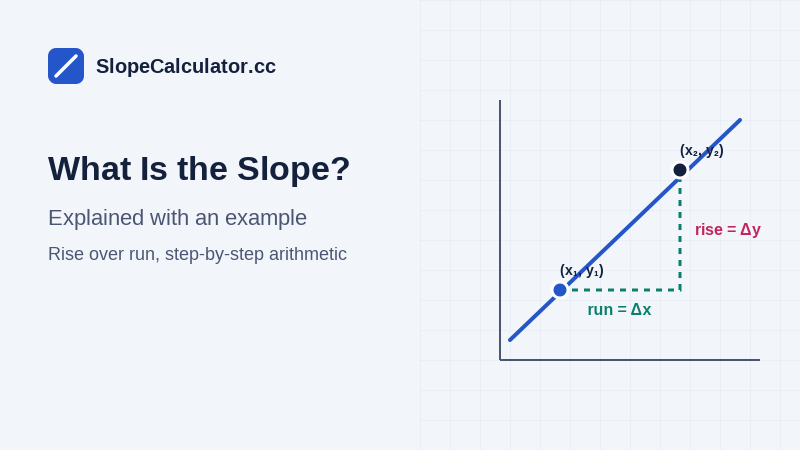
You will often hear slope described as rise over run. Each part of that phrase describes a step on your grid:
- Rise is vertical change. Count how many units you move up or down. Moving up gives a positive rise. Moving down gives a negative rise.
- Run is horizontal change. Count how many units you move from left to right. Moving right gives a positive run.
Because slope is a fraction, we write it as:
The Greek letter delta (Δ) means “change in.” So Δy is the change in height. The symbol Δx is the change in horizontal position. If a line climbs 6 units while moving 2 units right, the slope is 6 divided by 2, which equals 3. For each 1 unit right, the line climbs 3 units up. To measure change over time, explore our rate of change tool.
The formal slope formula
You can find the slope without counting squares. Use the coordinates of two points: (x₁, y₁) and (x₂, y₂). The formula is:
Here is how the formula works:
- y₂ − y₁ finds the vertical rise by subtracting the y-values.
- x₂ − x₁ finds the horizontal run by subtracting the x-values.
- The letter m represents slope in algebra.
Keep the same point first in both the top and bottom. The math will work out smoothly every time.
Worked example using two points
Let us find the slope between two sample points:
Step 1: Label your coordinates
Label each coordinate clearly so numbers stay organized:
- x₁ = 3
- y₁ = 7
- x₂ = 7
- y₂ = 19
Step 2: Set up the slope formula
Put these four numbers into the slope formula:
Step 3: Calculate the rise and the run
Subtract the numbers on the top and bottom separately:
- Vertical rise: 19 − 7 = 12
- Horizontal run: 7 − 3 = 4
The fraction is:
Step 4: Simplify the fraction
Divide 12 by 4 to get our final slope value:
The slope is 3. On a graph, start at Point (3, 7). Move 1 step right. You must climb 3 steps up to stay on the line. After moving 4 steps right, you will climb 12 steps up, landing at Point (7, 19). You can also measure the straight-line distance with our distance tool.
The four types of slope
Every straight line falls into one of four categories:
- Positive slope: The line rises from left to right. As x increases, y also increases. Examples include walking uphill or saving money steadily.
- Negative slope: The line falls from left to right. As x increases, y decreases. Examples include sledding downhill or water draining from a tub.
- Zero slope: The line is completely flat and horizontal. There is horizontal run, but zero vertical rise. The slope equals 0. Examples include a flat table or a level floor.
- Undefined slope: The line goes straight up and down. It has vertical rise, but zero horizontal run. Dividing by zero is impossible. This is why vertical lines have an undefined slope. Examples include a flagpole or an elevator cable.
Real world comparisons of slope
Slope is not just an idea on paper. We encounter slopes everywhere in daily life:
| Situation | Slope Description | Typical Slope Value | What It Means |
|---|---|---|---|
| Wheelchair ramp | Gentle positive slope | 1:12 or 8.33% | Rises 1 inch for every 12 inches of run |
| Mountain road grade | Moderate positive or negative | 6% to 8% | Climbs or drops 6 to 8 feet per 100 feet |
| Standard house roof | Medium slope | 4:12 to 6:12 | Rises 4 to 6 inches per 12 inches of run |
| Level floor | Zero slope | 0 | Flat surface with zero height change |
| Flagpole or wall | Undefined slope | Undefined | Straight vertical line with zero run |
You can also check slopes as a percentage grade.
How to find slope directly from a graph
Sometimes a problem does not give you coordinates. Instead, it gives you a line on a grid. You can find the slope directly by counting grid squares:
- Find two clean grid corners: Look along the line for spots where the line crosses right through the intersection of two grid lines. These are clean integer points. Avoid spots where the line passes through the middle of a square.
- Mark the two dots: Circle the two intersection points. For example, you might spot points at (1, 2) and (4, 8).
- Count the vertical rise: Start at the left point. Count straight up until you reach the height of the second point. In this example, you count up 6 squares. The rise is +6.
- Count the horizontal run: Now count straight right until you hit the second point. Here, you count right 3 squares. The run is +3.
- Divide rise by run: Write the fraction 6/3. Dividing 6 by 3 gives a slope of 2.
Counting squares is a fast way to check work. It proves the line rises 2 units for every 1 unit right.
Slope as a rate of change in science class
In science class, slope often measures speed or flow rate:
- Speed on a distance-time graph: When time is on the x-axis and distance is on the y-axis, the slope equals speed. If a runner travels 200 meters in 25 seconds, the rise is 200 meters. The run is 25 seconds. The slope is 200 / 25 = 8 meters per second.
- Steep lines mean fast speeds: A steep distance line means an object moves quickly. A flat line means the object has stopped moving.
- Water flow rates: If a bucket fills with 12 liters of water over 3 minutes, the slope is 12 / 3 = 4 liters per minute.
A quick slope checklist
Follow this simple checklist on homework problems:
- Choose two distinct points on the grid.
- Write down the coordinates clearly: (x₁, y₁) and (x₂, y₂).
- Put y-values on top of the fraction and x-values on the bottom.
- Keep subtraction order consistent: (y₂ − y₁) / (x₂ − x₁).
- Watch out for double negatives when subtracting negative numbers.
- Simplify your fraction to lowest terms.
- Look back at the line: rising lines are positive; falling lines are negative.
Common mistakes when finding slope
Avoid these frequent mistakes when working with slope:
- Putting x on top instead of y: Remember that rise goes up and down along the y-axis. The y-values always go on top.
- Mixing up subtraction order: If you start with y₂ on top, you must start with x₂ on the bottom. Flipping the order flips the sign of your answer.
- Dropping negative signs: Subtracting a negative number is like adding: 5 − (−3) = 8. Dropping signs leads to calculation errors.
- Confusing zero slope with undefined slope: A horizontal line has a slope of 0. A vertical line has an undefined slope. Never write “zero” for a vertical line.
Slope fundamentals FAQs
Why is slope represented by the letter m?
The most popular theory connects m to the French word monter, which means “to climb.” Others believe it was simply chosen alphabetically by early algebra teachers.
Can a slope be a negative fraction?
Yes. If a line drops 3 units while running 4 units right, its slope is −3/4. A negative fraction means the line slants downward to the right.
What happens if I switch the two points?
The math gives the exact same result. Both the numerator and denominator flip signs. The two negative signs cancel each other out.
How does slope relate to the steepness of a hill?
A larger slope number means a steeper hill. A slope of 4 is much steeper than a slope of 1/2. Even with negative slopes, −5 is steeper than −1.
Can two different lines have the exact same slope?
Yes. Parallel lines share the exact same slope. They slant at the same rate and never cross on a flat grid.