When an algebra problem gives you a slope and a single point, solving for the y-intercept takes extra work. You have to plug in numbers and solve for b. But there is a faster, simpler tool: point-slope form.
Point-slope form lets you write the line equation immediately. You use the coordinates of any known point and the slope. In this guide, we explain what point-slope form is. We show how it comes from the basic slope formula. We also show how to turn it into slope-intercept and standard forms. Finally, we walk through four complete worked examples.
What is point-slope form
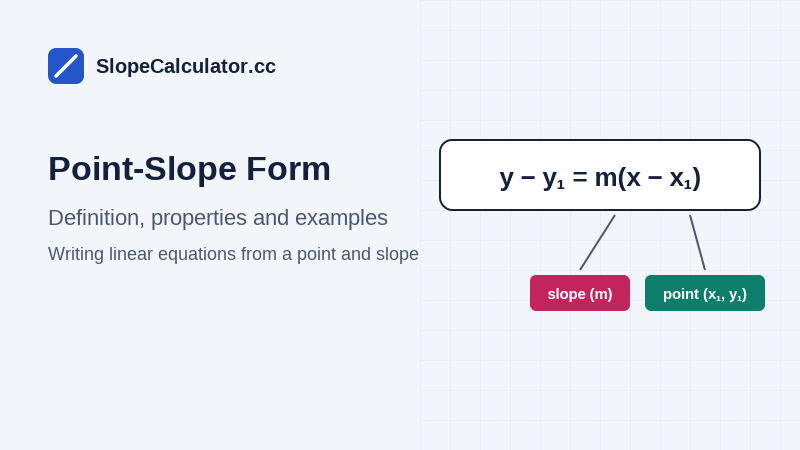
Point-slope form defines a straight line from its slope m and one known point (x₁, y₁). It is written as:
Here is what each part means:
- x and y are the general variables that stay in the equation.
- m is the slope of the line (rise over run).
- x₁ is the horizontal value of your known point.
- y₁ is the vertical value of your known point.
The minus signs belong to the template formula. You subtract the known numbers from x and y. When a coordinate is negative, subtracting a negative number turns into addition. To check your work, test your points in our point-slope form calculator.
How point-slope form is derived
Point-slope form is just the regular slope formula written on one line. It is not a separate formula to memorize.
Remember the definition of slope between a known point (x₁, y₁) and any point (x, y):
To clear the fraction, multiply both sides by (x − x₁):
The bottom part on the right side cancels out:
Flip the two sides to get point-slope form:
This simple proof shows how the formula works. It rearranges the slope formula so you do not have fractions.
Converting to other equation forms
Point-slope form is great for writing equations quickly. But homework problems often ask for slope-intercept form (y = mx + b) or standard form (Ax + By = C). Converting between them is straightforward:
Converting to slope-intercept form (y = mx + b)
- Distribute the slope m: Multiply m across the parentheses:
y − y₁ = mx − m · x₁
- Isolate y: Add y₁ to both sides:
y = mx − m · x₁ + y₁Combine the numbers on the right into one constant. That constant is your y-intercept b.
Converting to standard form (Ax + By = C)
- Start with y = mx + b. Move both x and y to the same side of the equal sign.
- If any numbers are fractions, multiply every term by the common denominator.
- Make sure the number A in front of x is positive.
Four worked examples
Here are four complete problems that demonstrate how to write and convert equations using point-slope form.
Example 1: Given a point and a positive slope
Write the equation of a line with slope m = 2 that passes through the point (4, 13), then write it in slope-intercept form.
- Identify your known values: m = 2, x₁ = 4, and y₁ = 13.
- Plug them directly into point-slope form:
y − 13 = 2(x − 4)
- Distribute the slope 2 across the parentheses:
y − 13 = 2x − 8
- Add 13 to both sides to isolate y:
y = 2x − 8 + 13 → y = 2x + 5The final equation in slope-intercept form is y = 2x + 5.
Example 2: Given a point with negative coordinates
Find the equation of a line passing through (−3, 6) with a slope of m = −4.
- Identify parameters: m = −4, x₁ = −3, and y₁ = 6.
- Plug into point-slope form, paying close attention to the negative sign:
y − 6 = −4(x − (−3))y − 6 = −4(x + 3)
- Distribute the −4:
y − 6 = −4x − 12
- Add 6 to both sides:
y = −4x − 12 + 6 → y = −4x − 6The line has a slope of −4 and a y-intercept of −6.
Example 3: Finding an equation from two points
Find the equation of a line passing through the two points (5, 8) and (8, 17).
- Find the slope first using rise over run:
m = (17 − 8 / 8 − 5) = (9 / 3) = 3
- Pick either point to plug into point-slope form. Let us pick (5, 8):
y − 8 = 3(x − 5)
- Distribute the 3:
y − 8 = 3x − 15
- Add 8 to both sides:
y = 3x − 15 + 8 → y = 3x − 7If you picked (8, 17), the math gives y − 17 = 3(x − 8). That also simplifies to y = 3x − 7. You get the exact same line either way. You can verify your points with our slope calculator or review the basics in our explanation of what slope means with examples.
Example 4: A line with a horizontal slope
Write the equation of a line passing through (6, −2) with a slope of m = 0.
- Plug m = 0, x₁ = 6, and y₁ = −2 into point-slope form:
y − (−2) = 0(x − 6)y + 2 = 0
- Subtract 2 from both sides:
y = −2Any line with zero slope is flat. The value of y stays constant. For lines that meet at right angles, you can also learn about perpendicular bisectors.
Real-world situations where point-slope form shines
Point-slope form is very helpful when solving word problems with steady rates:
- Draining a pool: A pool holds 12,000 gallons after 4 hours of pumping. The pump removes 500 gallons every hour. The rate gives a slope of m = −500. The point is (4, 12000). The equation is y − 12000 = −500(x − 4). You can find the water level at any hour without guessing the starting volume.
- Hiking uphill: A hiker reaches 3,200 feet of elevation after 2 hours. She climbs steadily at 450 feet per hour. Her rate gives m = 450. The point is (2, 3200). Her equation is y − 3200 = 450(x − 2).
- Saving allowance money: You have 45 dollars saved after 3 weeks. You add 12 dollars each week. The slope is m = 12. The point is (3, 45). The equation is y − 45 = 12(x − 3).
- Car trip gas use: A family car has 10 gallons left in the fuel tank after driving 120 miles. The car burns 1 gallon every 30 miles, so the slope is −1/30. The point is (120, 10). The equation is y − 10 = −(1/30)(x − 120).
In each story, point-slope form lets you write the rule immediately from the facts. You do not have to work backwards to find the starting number.
Comparing point-slope form with other forms
Choosing the right format saves time on exams:
| Linear Form | Equation Structure | When to Choose It |
|---|---|---|
| Point-Slope Form | y − y₁ = m(x − x₁) | You know the slope and any point on the line |
| Slope-Intercept Form | y = mx + b | You need to graph the line or read the y-intercept |
| Standard Form | Ax + By = C | You are working with systems of equations |
| Two-Intercept Form | (x / a) + (y / b) = 1 | You know the two axis intercept points |
Common mistakes when using point-slope form
Avoid these frequent mistakes when working with point-slope equations:
- Mixing up x and y positions: Remember that y₁ sits on the left with y. The value x₁ sits on the right inside parentheses.
- Dropping negative signs: The formula has minus signs built into it. When x₁ = −4, the expression becomes x + 4.
- Forgetting to distribute the slope to both terms: When expanding 3(x − 5), remember to multiply both numbers. You get 3x − 15.
- Trying to use point-slope form for vertical lines: A vertical line has an undefined slope. It has no numerical m value. Write a vertical line directly as x = h.
Point-slope form FAQs
Can I pick either point when two points are given?
Yes. Both points lie on the same line. Either point produces the same final line equation.
Why is point-slope form often preferred over slope-intercept form?
When the y-intercept is an awkward fraction like 17/7, solving for b takes extra arithmetic. With point-slope form, you write the equation in seconds without fraction addition.
What happens if the given point is the y-intercept?
If your known point is (0, b), the equation becomes y − b = m(x − 0). This simplifies to y = mx + b right away.
Can the slope m be a fraction in point-slope form?
Yes. An equation like y − 3 = (2 / 5)(x − 4) is completely valid. You can multiply by 5 to clear fractions or convert to a slope-intercept equation.
How do I find the x-intercept from a point-slope equation?
Set y equal to zero and solve for x. For example, in y − 4 = 2(x − 1), setting y = 0 gives −4 = 2(x − 1). Dividing by 2 gives −2 = x − 1, so x = −1. The x-intercept is (−1, 0).